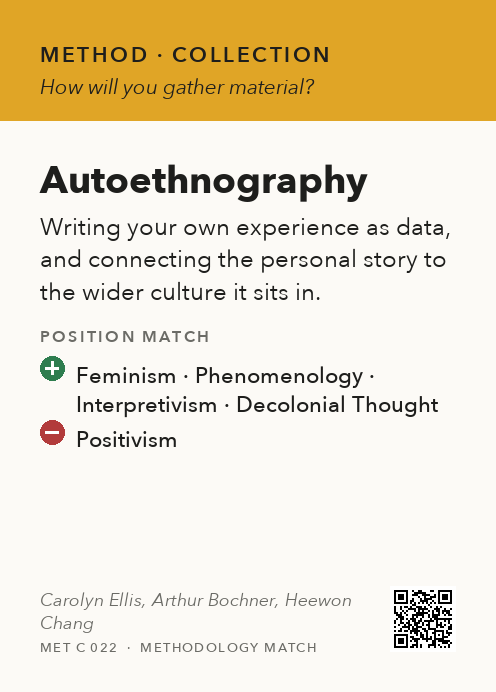
Writing your own experience as data, and connecting the personal story to the wider culture it sits in.
- +Fits Feminism, Phenomenology, Interpretivism, Decolonial Thought
- –Tension with Positivism
Key thinkers: Carolyn Ellis, Arthur Bochner, Heewon Chang
The longer story
Autoethnography uses the researcher's own experience as evidence, written up with enough care that it says something about the culture it comes from. The "auto" is the self, the "ethno" is the culture, and the "graphy" is the writing: all three matter. A diary is not autoethnography until the personal account is connected to a wider question.
It is common in practice research, where the person who knows most about the process is the one doing it. Its critics call it self-indulgent; its defenders reply that pretending the researcher is absent is the greater fiction. Either way it raises real ethical questions, because your story includes other people who did not agree to be in it.