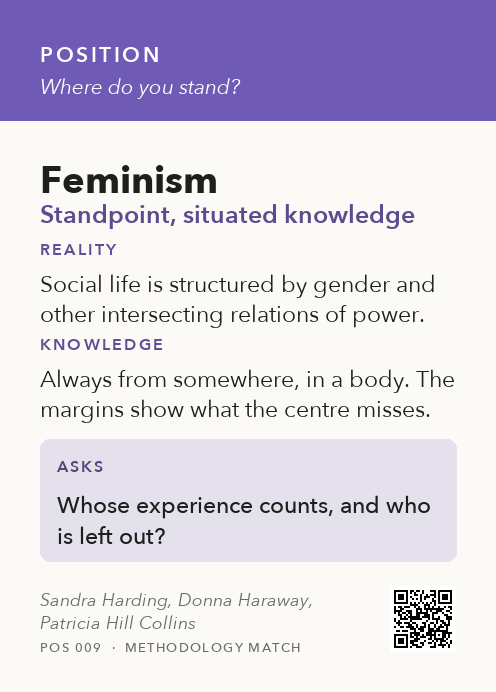
Social life is structured by gender and other intersecting relations of power.
Always from somewhere, in a body. The margins show what the centre misses.
Whose experience counts, and who is left out?
Key thinkers: Sandra Harding, Donna Haraway, Patricia Hill Collins
The longer story
Feminist research starts from the fact that knowledge has mostly been produced by a narrow group of people, who mistook their own position for neutrality. Standpoint theorists such as Harding and Hill Collins argue that those on the margins often see how power works more clearly, because they have to. Haraway's "situated knowledges" makes the wider point: all knowing is from a body, in a place.
In practice this means attending to whose experience is treated as evidence, how the researcher's own position shapes the work, and who benefits from it. Intersectionality extends the analysis beyond gender to race, class, disability and sexuality, which rarely operate one at a time.