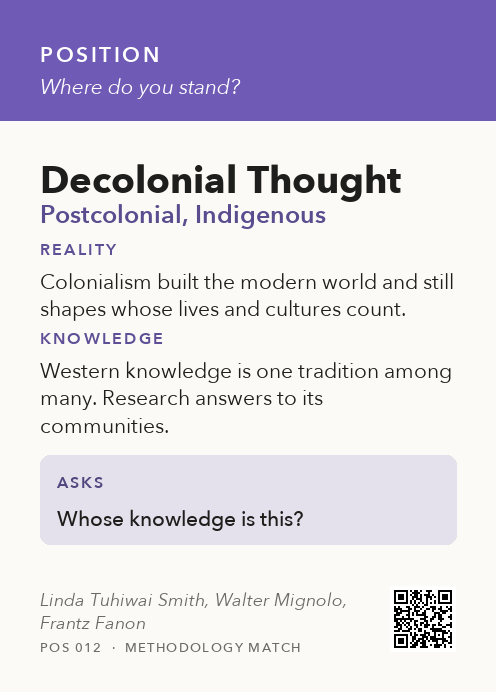
Colonialism built the modern world and still shapes whose lives and cultures count.
Western knowledge is one tradition among many. Research answers to its communities.
Whose knowledge is this?
Key thinkers: Linda Tuhiwai Smith, Walter Mignolo, Frantz Fanon
The longer story
Decolonial thought argues that colonialism was not only a matter of land and labour. It also ranked knowledge, treating European ways of knowing as universal and everyone else's as belief, folklore or raw material. That ranking outlived the empires. Postcolonial writers such as Said and Fanon analysed it; Linda Tuhiwai Smith's Decolonizing Methodologies turned the analysis on research itself, written from a Māori perspective.
The practical consequences are concrete. Who asked for this research? Who owns what it produces? Are communities partners or sources? Whose categories are being used? In museum, archive and heritage research these questions are now hard to avoid. Indigenous methodologies are traditions in their own right, not a branch of Western critique.