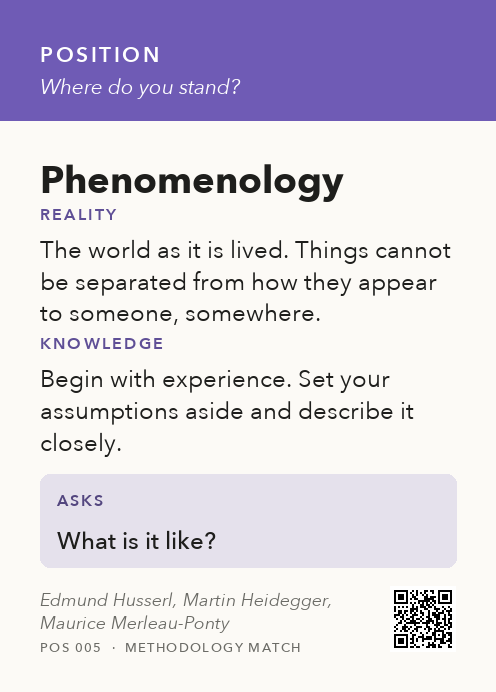
The world as it is lived. Things cannot be separated from how they appear to someone, somewhere.
Begin with experience. Set your assumptions aside and describe it closely.
What is it like?
Key thinkers: Edmund Husserl, Martin Heidegger, Maurice Merleau-Ponty
The longer story
Phenomenology is the study of experience as it is lived, before we explain it away. Not "what happens in the brain when someone listens to music?" but "what is it like to listen?" Husserl asked researchers to bracket their assumptions and describe what appears. Heidegger and Merleau-Ponty added that experience always belongs to someone who has a body, a history and a place in the world.
It is widely used in research on making, performing, viewing and listening, because those are things that have to be undergone to be understood. The test of good phenomenological writing is recognition: a reader who has had the experience should think, yes, that is how it is.