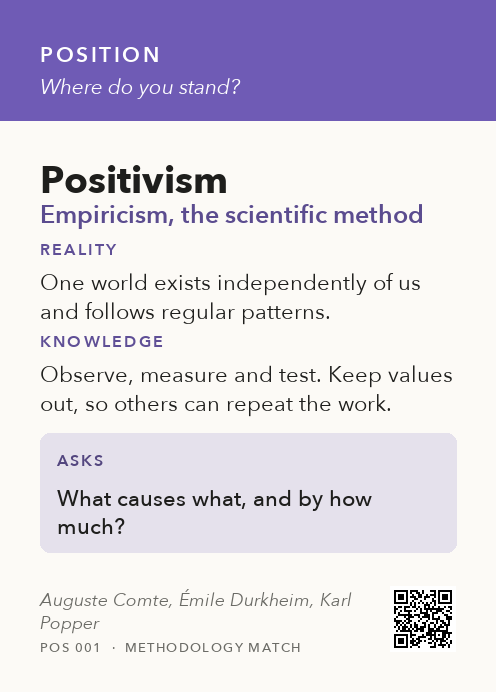
One world exists independently of us and follows regular patterns.
Observe, measure and test. Keep values out, so others can repeat the work.
What causes what, and by how much?
Key thinkers: Auguste Comte, Émile Durkheim, Karl Popper
The longer story
Positivism treats the social world much as a physicist treats the natural one: there are regularities out there, and careful observation and measurement can find them. The researcher tries to stay out of the picture, so that someone else running the same study would get the same result. Most researchers who work this way today are post-positivists: they accept that observation is never perfectly neutral, but still aim for it.
In arts research it turns up in audience surveys, eye-tracking, experimental aesthetics and anything that counts. If your question is "how many?" or "does A cause B?", this is your home ground. If it is "what does this mean?", expect an argument.