Find your question.
Build the thesis that answers it.
Methodology Match is a card game for people designing research. Everyone works towards a research question about the same object of study, and a thesis that can answer it. Then the table tests whether question and design hold together. Nobody scores points. Viva la viva.







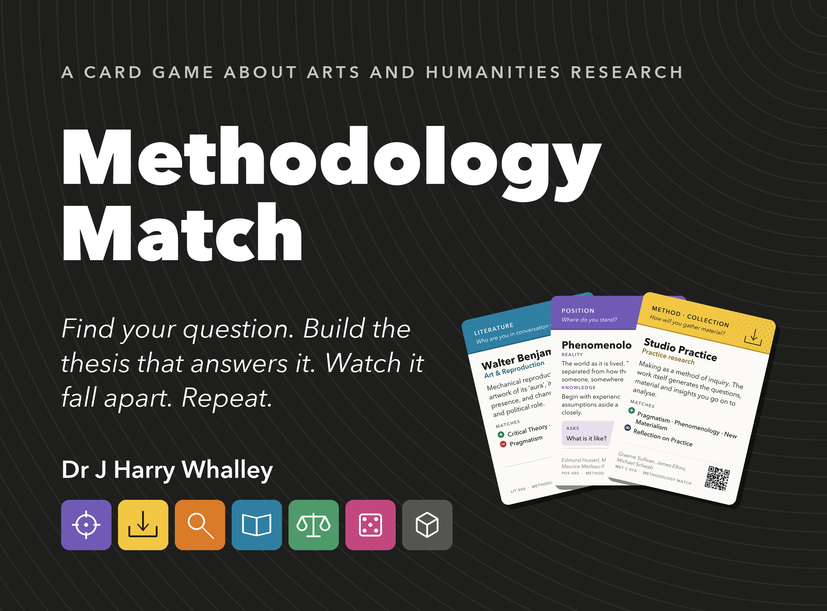
One position, and the cards that fit it
A thesis has one Position. Every other card has to fit it, and a method of collection and a method of analysis that pair are strongest together. Some of the cards you draw will not fit. Each card that stays changes the research question. There are 22 games, dealt in a different order each time.
Why do the 'empty rooms' painted in northern Europe around 1900 speak so directly to viewers who have lived through a lockdown?
Gadamer adds the viewer's own time, and the question becomes one that could not have been asked in 1900.
Everyone at the table studies the same object.
Hermeneutics asks what a work says, and to whom.
+ Fits HermeneuticsA corpus of works fits because interpretation needs a defined set of works to read.
+ Fits Hermeneutics∞ Pairs with Corpus of WorksClose reading fits Hermeneutics, and it works through the corpus one painting at a time.
+ Fits HermeneuticsGadamer fits because he argued that a work's meaning changes with the reader's own time.
The corpus gives a set of paintings to read, close reading finds the doors and turned backs that recur in them, and Gadamer explains why they say something new to a viewer now.
Pause stops the game where it is. Step through deals one card at a time and waits for you. Select a card to turn it over. These are examples: the matches on the cards are there to be argued with.
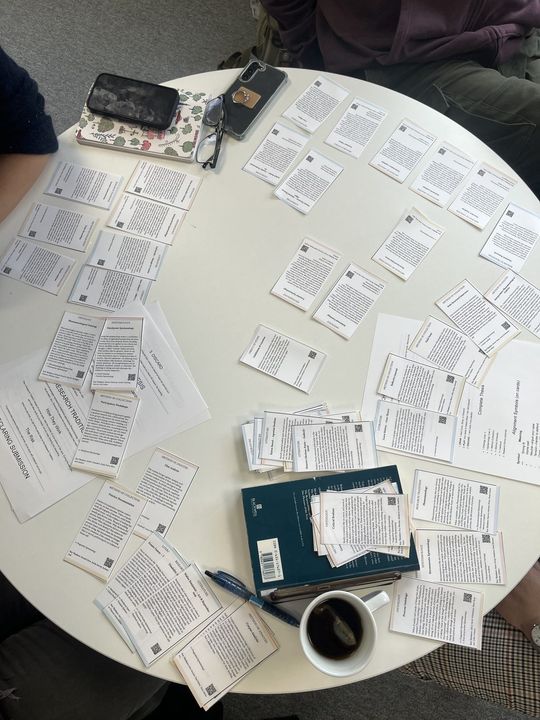
First played at UCA in December 2025
The first printed version had 135 cards in black and white. Research students on the research methods course at the University for the Creative Arts played it, and several of them asked for a set of their own.
What you build
One research question, and the chain of four choices that can answer it. Your Position says what kind of question you are asking. Every other card says which positions it fits and which it is in tension with.
How it plays
- Draw a card From the Positions deck, the Toolkit deck, or the discard pile. Hands are face-up, so everyone can read and help.
- Play one or discard one Add a card to your thesis, or give one up, and your turn is over. You can rewrite your question whenever the cards change your thinking.
- Test the question When a thesis is complete, everyone reads out their question and the cards that answer it. Is it about the object? Does it belong to the position? Could the methods answer it?
2–4 players or teams · 20–30 minutes · no card-game experience needed
Two decks
- 54 cards Standard deck The whole game for two or three players or teams: 8 positions, the methods and writers that arts and design researchers meet first, and 9 objects of study.
- 54 more cards Additional deck Shuffle it in for four players or more variety: 4 more positions, more methods, writers, ethics and objects. Its cards carry a small diamond. It cannot be played without the standard deck.
Who it is for
Doctoral and master’s researchers, especially in the arts, design, humanities and social sciences, and the people who teach them research methods. Editions for other fields are planned. The cards also work as flashcards: name on the back, definition on the front. Scan the QR code on any card to reach its page here.
Made by Harry Whalley at the University for the Creative Arts (UCA), where it is used in research methods teaching for research students.