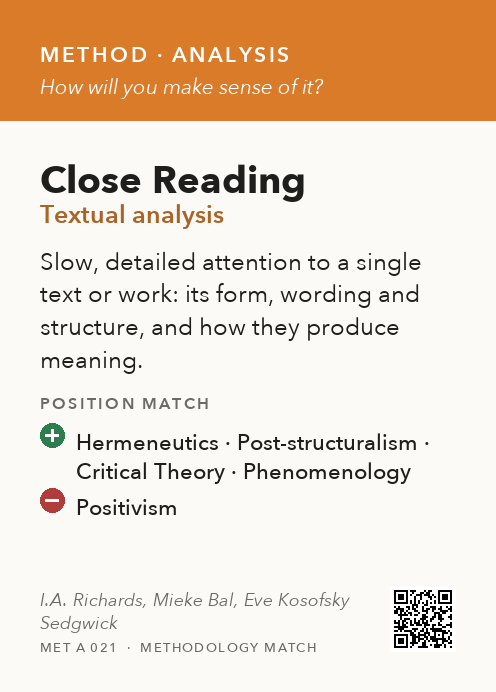
Slow, detailed attention to a single text or work: its form, wording and structure, and how they produce meaning.
- +Fits Hermeneutics, Post-structuralism, Critical Theory, Phenomenology
- –Tension with Positivism
Key thinkers: I.A. Richards, Mieke Bal, Eve Kosofsky Sedgwick
The longer story
Close reading is the basic analytical act of the humanities: slow, patient attention to how a particular work is made. Word choice, rhythm, framing, an edit, a brushstroke, a chord. The claim is that form is not decoration; how something is said is part of what is said.
It began in literary criticism but the habit travels to images, films, scores, buildings and objects. The discipline lies in staying with the evidence in front of you and showing your reader exactly where in the work your claim comes from. Its limit is scale: a close reading of one poem tells you little about ten thousand, which is why some researchers pair it with "distant reading".