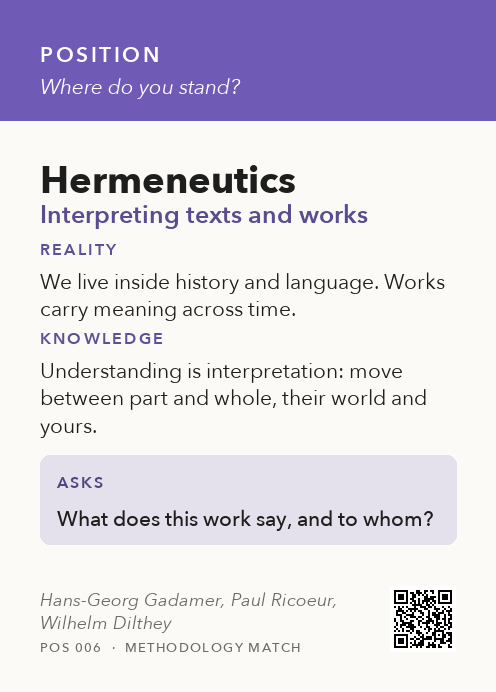
We live inside history and language. Works carry meaning across time.
Understanding is interpretation: move between part and whole, their world and yours.
What does this work say, and to whom?
Key thinkers: Hans-Georg Gadamer, Paul Ricoeur, Wilhelm Dilthey
The longer story
Hermeneutics began as the craft of interpreting difficult texts, scripture and law, and grew into a general account of understanding. Its central image is the hermeneutic circle: you understand a part of a work in the light of the whole, and the whole in the light of its parts, going round until the reading settles.
Gadamer's addition is that the interpreter is never neutral. You bring your own moment in history to the work, and understanding happens when your horizon and the work's horizon meet. This is the unspoken position of much art history, musicology and literary study: the meaning is not simply in the object, nor simply in you, but in the encounter.