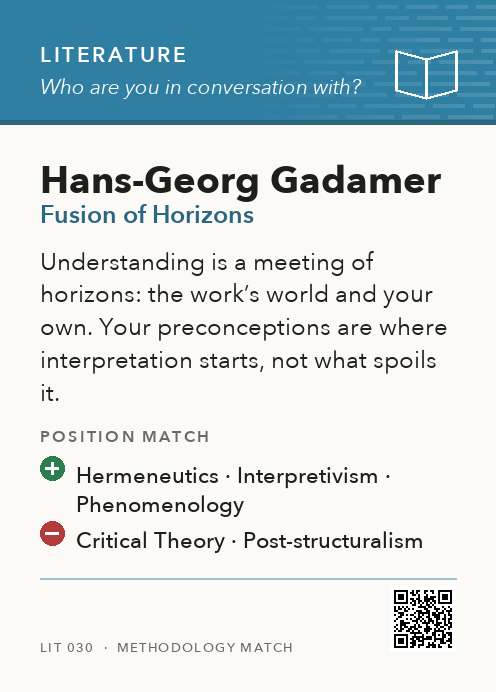
Understanding is a meeting of horizons: the work’s world and your own. Your preconceptions are where interpretation starts, not what spoils it.
- +Fits Hermeneutics, Interpretivism, Phenomenology
- –Tension with Critical Theory, Post-structuralism
The longer story
Hans-Georg Gadamer's Truth and Method (1960) argues that understanding a work is not a technique you apply from outside. You always arrive with a horizon: your language, your training, your moment in history, your expectations. The work has a horizon too. Understanding happens when the two meet and yours is changed by the encounter. He called this a fusion of horizons.
Two consequences matter for researchers. First, your preconceptions (he provocatively called them prejudices) are not contamination to be scrubbed away; they are the only place interpretation can start, provided you let the work question them. Second, a work's meaning is never finished, because each generation meets it from somewhere new. That is why a score, a painting or a text can be interpreted again without the earlier readings being wrong.
He is a natural companion for musicology, art history, performance and any research that interprets works. His critics pressed him from two sides: Habermas argued that tradition can carry distortion and power that need critique, not only dialogue; Derrida doubted that understanding ever arrives at the agreement Gadamer hoped for.