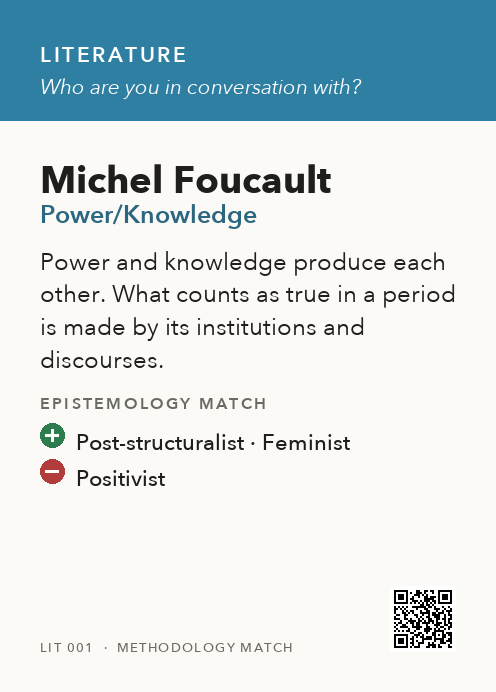
Power and knowledge produce each other. What counts as true in a period is made by its institutions and discourses.
- +Fits Post-structuralist Epistemology, Feminist Epistemology
- –Tension with Positivist Epistemology
The longer story
Foucault rejected 'post-structuralist' as an American invention, yet his work is constantly mobilised in that tradition. His big move was connecting power and knowledge so tightly you can't separate them—'power/knowledge' as one word. What counts as knowledge is itself a power effect. Prisons produce criminology; clinics produce psychiatry; schools produce pedagogy. Discourses don't just describe reality; they constitute what can be thought and said. For research, Foucault gives you genealogy—tracing how categories came to seem natural, whose interests they serve, what they make impossible to think. Uncomfortable tools because they apply to your own work too.