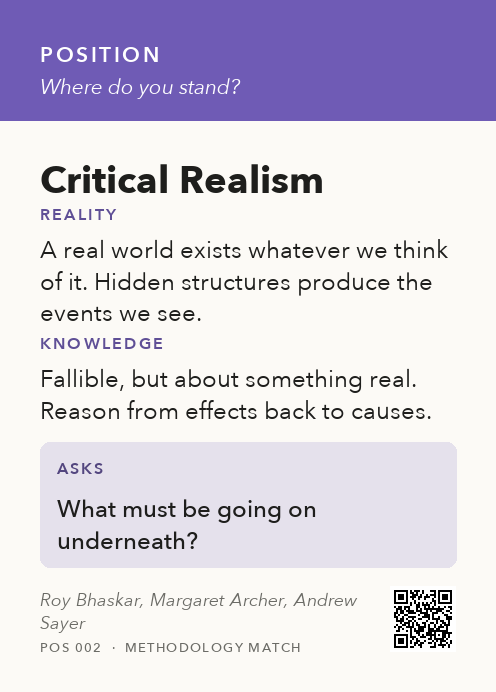
A real world exists whatever we think of it. Hidden structures produce the events we see.
Fallible, but about something real. Reason from effects back to causes.
What must be going on underneath?
Key thinkers: Roy Bhaskar, Margaret Archer, Andrew Sayer
The longer story
Critical realism holds two things together. There is a real world that does not depend on what we think about it, and our knowledge of that world is always partial, fallible and shaped by theory. What we observe (events, statistics, things people say) is the surface. Underneath are structures and mechanisms that produce it: markets, institutions, class, gender relations.
The characteristic move is to reason backwards: given that this happened, what must exist for it to be possible? It suits research that wants to explain as well as describe, and it is comfortable mixing numbers with interviews, because both are evidence about the same underlying reality.