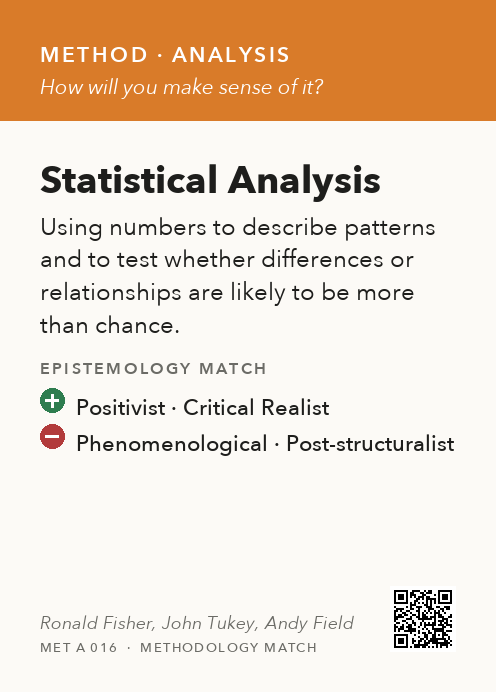
Using numbers to describe patterns and to test whether differences or relationships are likely to be more than chance.
- +Fits Positivist Epistemology, Critical Realist Epistemology
- –Tension with Phenomenological Epistemology, Post-structuralist Epistemology
Key thinkers: Ronald Fisher, John Tukey, Andy Field
The longer story
Statistical analysis describes data mathematically and tests whether patterns are likely to be real. Descriptive statistics summarise: means, distributions, correlations. Inferential statistics generalise: can you conclude something about a population from a sample? Choose tests appropriate to your data type and research question. Effect sizes tell you whether a finding matters practically. P-values are not what people think they are. The numbers don't speak for themselves—interpretation requires understanding what the statistics can and can't show.