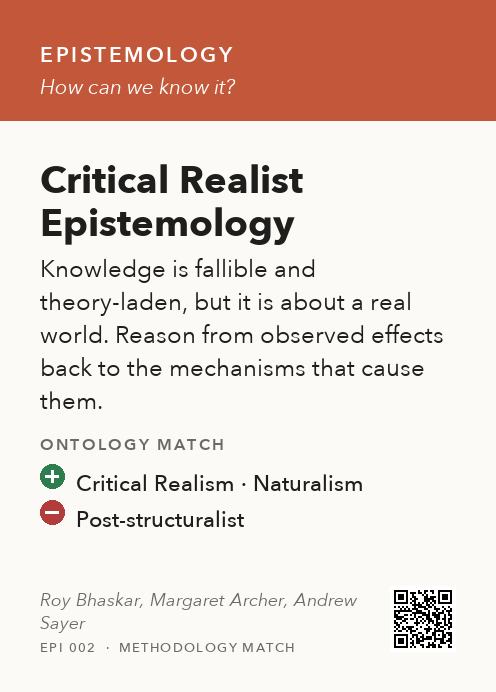
Knowledge is fallible and theory-laden, but it is about a real world. Reason from observed effects back to the mechanisms that cause them.
- +Fits Critical Realism, Naturalism
- –Tension with Post-structuralist Ontology
Key thinkers: Roy Bhaskar, Margaret Archer, Andrew Sayer
The longer story
Critical realism is primarily an ontological position—stratified reality, emergent powers, hidden mechanisms—but it carries epistemological commitments. We can know reality, but only indirectly, fallibly, partially. You can't observe social structures or causal mechanisms directly—you see their effects and reason backwards (retroduction). Knowledge is always theory-laden; we approach the world through concepts. But some theories are better than others, and we can tell which by explanatory power. It's not relativism—truth exists and we can get closer to it. But it's not naive realism either. We're always making inferences about hidden causes from visible effects.